Wednesday, April 4, 2012

29 YR OLD WOMAN HEARING OWN VOICE FOR THE FIRST TIME

A video of a deaf woman hearing her own voice for the first time with the help of a hearing implant has gone viral and has received over 12 million hits! 
The video of Sarah Churman, shot in October, 2011, was posted on YouTube and shows herself hearing her voice loud and clear for the first time after being implanted with Envoy Medical’s Esteem device. The video went viral, Envoy Medical’s sales spiked and Churman and the company shared the spotlight on The Today Show, Ellen DeGeneres, Fox and Friends, and CNN’s Anderson Cooper and Dr. Sanjay Gupta, among others. The story was also covered on 150 local television stations.
Churman, 29, was born deaf and relied on reading lips and hearing aids until she received a surgically-implanted device. On her YouTube channel, Churman wrote, “I was born deaf and eight weeks ago I received a hearing implant. This video of them turning it on and me hearing myself for the first time.”
In the video shot by her husband and posted on video-sharing website YouTube, Churman cries as she hears sounds, including her own voice and her husband’s laughter for the first time as the implant was activated.
During her appearance on “Ellen,” Churman learned that Envoy was giving her an implant for her other ear. That happened earlier this year, and, again, Churman recorded her reaction.
After Churman received her second implant, her husband again videotaped the moment the device was activated. While you don’t get the pure, unadulterated joy that you did in her first video, it is still interesting to see someone hear in stereo for the first time. Churman first describes it as “weird” but really tarts to like the new sensation after about a minute.
According to the company’s website, the implant is the only fully surgically-implantable hearing device for sensorineural hearing loss that uses the natural ear as a microphone.
The implant, which is not visible on the user, has a sound processor implanted behind the outer ear and two transducers implanted in the middle ear to use the eardrum as a microphone, picking up the sounds through the ear canal.

Wednesday, March 21, 2012

Study shows Mild Hearing Loss TRIPLES Risk of Having a Fall

The risk of falling rises threefold even with the mildest hearing loss, according to a study. For moderate deafness, the chance of an accident doubles again – probably because such people have a poorer sense of their surroundings and are more likely to trip.
The researches also suggested that the brain may not be able to focus on balance and gait when it is struggling with hearing. 
The study at Johns Hopkins University School of Medicine, Baltimore, was based on the health records of more than 20,000 patients aged from 40 to 69.
Dr. Frank Lin at Johns Hopkins, and his colleague Luigi Ferrucci of the National Institution on Aging, used data from the 2001 to 2004 cycles of the National Health and Nutrition Examination Survey.
The ongoing survey has gathered health data from thousands of Americans since 1971.
During those years, 2,017 people aged 40 to 69 had their hearing tested and answered questions about whether they had fallen over the past year. 
Researchers also collected personal information including age, sex and race and tested participants’ vestibular function, a measure of how well they kept their balance.
The findings show that people with a 25-decibel hearing loss – classified as mild – were nearly three times more likely to have a history of falling. Every additional 10-decibels of hearing loss increased the chances of falling by 1.4 fold, says a report in the Archives of Internal Medicine journal.
A further 20-decibel hearing loss over the “mild” classification would push up the risk by threefold again.
Explanation: Dr. Lin, a hearing specialist and epidemiologist, says people can’t hear well may not have good awareness of their overall environment, making tripping more likely. 
This finding still held true, even when researchers accounted for other factors linked with falling, including age, sex, race, cardiovascular disease and vestibular function.
Even excluding patients with more moderate to severe hearing loss from the analysis didn’t change the results.
He said another reason hearing loss might increase the risk of falls is cognitive load, in which the brain is overwhelmed with demands on its limited resources.
“Gait and balance are things most people take for granted, but they are actually very cognitively demanding” he said.
“If hearing loss imposes a cognitive load, there may be fewer cognitive resources to help with maintaining balance and gait,” he added.

Wednesday, February 15, 2012

Hearing Aids will Change Your Life

Excessive drinking can cause loss of hearing.

Excessive alcohol consumption may affect our hearing, new research has found. While many people are aware of the obvious risks associated with binge drinking, it is not commonly known that excessive drinking can cause loss of hearing.
The Hearing Professionals explain that high alcohol consumption over a long period of time can result in damage to the central auditory cortex of the brain and may lead to brain shrinkage. As the damage to the auditory nerves adds up, even moderate drinkers may risk nerve damage and hearing loss.
Researchers from the University of Ulm in Germany tested both heavy and social drinkers’ Brainstem Auditory Evoked Potentials (BAEP) levels, by testing the level of damage in the part of the brain that enables one to hear. The results indicated that drinking affects the ability to hear.
The research shows that alcohol can result in brain damage, but the quantity of alcohol and the length of time needed to accomplish this remains unknown. Although the ears may continue to function perfectly, the brain is no longer able to process the sounds.
The study also shows that people who suffer from alcoholism may suffer damage within their ears.
The high levels of alcohol in the bloodstream can create a toxic environment known as ototoxicity, which can damage the delicate hair cells in the cochlea. We all know that alcohol can cause nerve and brain damage. However, this new research suggesting the link between alcohol and hearing loss is very interesting and would warrant further investigation. As people’s ability to hear reduces, it can often lead to other problems, such as less social interaction, lack of confidence, depression and irritability.
A previous British study has shown that alcohol and noise can cause temporary hearing loss. All of the participants in one study were found to have temporary hearing loss.
Researchers also believe that a regular ingestion of alcohol may lead to permanent hearing loss in the long term.

Wednesday, February 8, 2012

Best place to get your hearing aid fixed

If you suspect your hearing aid needs repair, take it back to the hearing care center where you purchased it, or another reputable office. Many times, hearing aids will require programming after repair.
Due to the complex circuitry in today’s hearing aids, having them repaired by the original hearing aid manufacturer is the bestoption. If your hearing aids are under warranty from the manufacturer, this can be done at a minimal charge to you, the hearing aid user.
Online or mail-order repair services may not be able to program your hearing aid back to its original settings. This can cause many problems, including difficulty in hearing, whistling and even severe feedback. It is best to return to the local office where your records, including fitting notes and hearing aid settings, are available to the provider and they can restore the hearing aid to the optimal settings for your hearing loss.
If your hearing aid is not under warranty, most manufactures will offer a 6-month or 12-month warranty with the new repair. Contact your local hearing care provider for specific charges in your particular situation.
If you have any questions about hearing loss or hearing aids, contact Hearing & Balance Associates at (850) 553-4327 or (850) 298-8407

Tuesday, February 7, 2012

What exactly is Sudden hearing loss?

Sudden hearing loss or sudden sensorineural hearing loss is defined by a sudden loss of hearing within a 72 hour period, resulting in greater than a 30 dB drop in hearing for at least three consecutive test frequencies.
Sudden Hearing Loss Symptoms – Sudden hearing loss most typically occurs in one ear and varies in severity from patient to patient. For some, the onset of the sudden hearing loss is reported to have been noticed instantaneously, often in the morning. Others report the onset of hearing loss occurred over a period of hours or often days.
Tinnitus (ringing in the ears) typically accompanies sudden hearing loss. Vertigo (dizziness) has also been reported to be present in roughly 40% of sudden hearing loss cases.
Sudden Hearing Loss Causes – Although the exact cause of sudden hearing loss is unknown for most people, there are many potential causes of sudden hearing loss, including viral infections, neurologic issues, metabolic and immunologic disease, toxicity, trauma to the inner ear, circulatory problems of the inner ear such as Meniere’s Disease, idiopathic (unknown) and others.
Sudden Hearing Loss Diagnosis and Treatment – People who experience a sudden loss of hearing should seek medical attention immediately from a qualified health professional.
The diagnosis of sudden hearing loss begins with having a full hearing evaluation to assess the amount of hearing loss that has occurred. Based on the audiogram and a full evaluation by a physician, the sudden hearing loss is diagnosed.
The physician may suspect possible causes based on case history and the physical evaluation. Blood work and image tests are also recommended to rule out possible medical causes.
Treatment for sudden hearing loss has been controversial and inconsistent among physicians due to the fact the cause of sudden hearing loss is often unknown. According to research presented at theAmericanAcademyof Otolaryngology – Head & Neck Surgery Foundation meeting in 2008, there are no official guidelines or position statements regarding the evaluation and treatment of sudden hearing loss (Friedland and Shemirani, 2008).
Currently the most common forms of treatment including oral steroids and anti-viral medication prescribed typically by either a family physician or an Otolaryngologist (ENT).
Between 32% and 65% of patients who experience sudden sensorineural hearing loss will recover. Recovery is more likely to occur if the time between onset of symptoms and treatment is a short interval, vertigo is absent, a mild to moderate hearing loss, a mid-frequency / upsloping audiometric pattern, and the patient’s age is of 15-40 years old. Because the chance of recovery is greater if the hearing loss is treated early – and because a significant percentage of patients do not recover their hearing – evaluation of treatment option is critical.

Monday, February 6, 2012

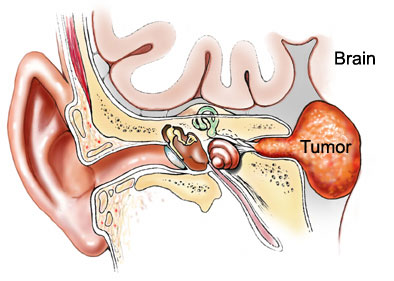
What is an Acoustic Neuroma?

What is an Acoustic Neuroma? An acoustic neuroma is a tumor of the cells surrounding the nerve that transmits balance information from the inner ear to the brain. It is not malignant; that is it does not produce cells that travel to other places in the body and start additional tumors. Nonetheless, an acoustic neuroma is a problem because it slowly grows toward the brain’s hearing, breathing, and blood pressure centers and compresses them. Untreated, acoustic neuromas can create serious neurological problems and even become life-threatening.
Normal healthy nerves are covered by a layer of cells called Schwann cells which function the same way that rubber or plastic coating on electrical wires work, providing insulation and support for nerve impulses. When these cells begin to grow and multiply at an abnormal rate, an acoustic neuroma occurs. Acoustic neuromas occur in only 1 out of 100,000 people per year and they generally happen in people who are between the ages of 30 and 60.
What Causes An Acoustic Neuroma? There are no well-defined causes for an acoustic neuroma. Some studiesperformed in the past have linked the tumor with prolonged exposure to loud noise, but this has not been confirmed. Other studies have indicated there maybe a link to radiation, but again this has not been confirmed. The vast majority of tumors are sporadic, meaning there is no genetic inheritance pattern.
What Are The Symptoms Of An Acoustic Neuroma? A symptom is something the patient senses and describes, while a sign is something other people, such as a doctor, notice. For example, drowsiness may be a symptom while dilated pupils may be a sign.
The first symptoms of an acoustic neuroma include gradual hearing loss in one ear with near normal hearing in the other ear, decrease in sound discrimination, especially when talking on the telephone and ringing in the affected ear, called tinnitus. More than 80% of patients have reported tinnitus, most often a unilateral high-pitched ringing like a steam kettle.
How Are Acoustic Neuromas Diagnosed? The gold standard for diagnosing an acoustic neuroma is an MRI scan of the brain. This is often performed with the contrast material, gadolinium, which helps to define the tumor precisely. An audiogram should be performed along with the MRI to test hearing function in both ears. Finally, some patients may undergo an auditory brainstem response test. This test measures the conduction of the electrical impulses along the nerve to the brain. A defect in conduction through this nerve may suggests the presence of a tumor.
What Are The Treatment Options? There are currently three man treatment options and physicians can choose from 1) observation; 2) surgery; or 3) radiation. Left untreated, an acoustic neuroma may cause neurological problems, including facial paralysis which can lead to blindness and brain damage severe enough to cause death. An acoustic neuroma always requires specialized and prompt treatment.
Conclusion. An acoustic neuroma is a complex medical problem requiring skilled care at all stages from diagnosis to rehabilitation. The audiologists and staff at The Hearing Professionals are not medical doctors and we do not give medical advice. We are, however, in a unique position because of the large amount of testing that we do for hearing loss and we are often the first people who will notice the possibility of a medical condition or possible acoustic neuroma.